

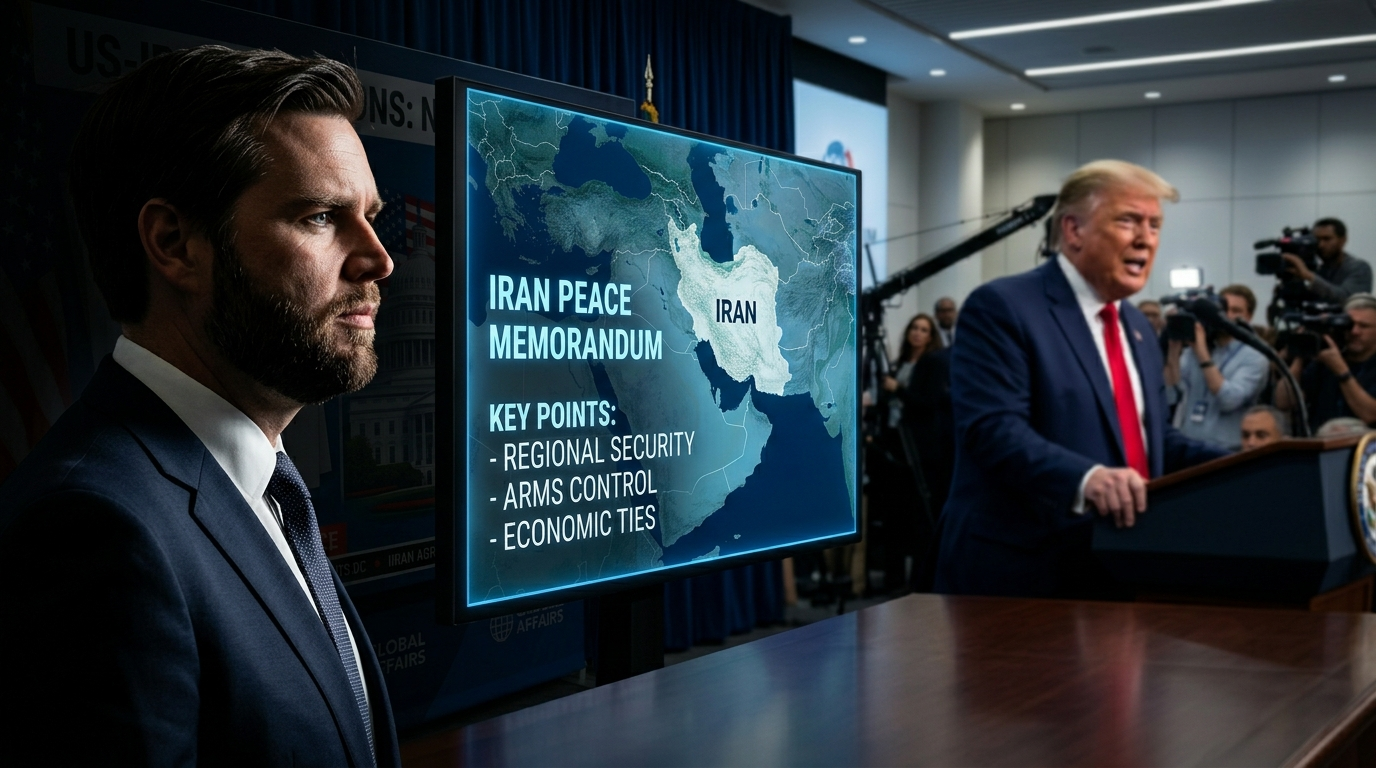
The shifting tides of global diplomacy have placed US Vice President JD Vance directly in the crosshairs of international scrutiny. In a characteristically candid and public display of high-stakes political management, President Donald Trump recently sent shockwaves through diplomatic circles during the G7 summit. When questioned about the unfolding and highly volatile negotiations surrounding a potential peace memorandum between Washington and Tehran, Trump half-jokingly remarked to reporters that he would happily take the credit if the diplomatic efforts succeeded, adding, “If it doesn’t work out, I’m blaming JD.”
- The Genesis of the Gambit: From Skeptic to Chief Closer
- 2026 Timeline: The Fragile Road to the Swiss Mountains
- Inside the Memorandum: High Risk, High Reward
- The Domestic Fallout and Washington Power Plays
- The Irreconcilable Variables: Israel and Lebanon
- Conclusion: The Final Verdict on Transactional Diplomacy
While delivered with a trademark grin, the statement perfectly encapsulates the immense, career-defining risk Vance has assumed by taking the lead on the administration’s Middle East files. For a politician who rose to prominence on a platform of strict non-interventionism, stepping forward as the chief architect of a complex US-Iran peace framework represents a massive political gamble. This unfolding narrative has quickly dominated Trump News Today, serving as a critical indicator of how the executive branch intends to navigate the treacherous waters of foreign policy while keeping a sharp eye on domestic political survival.
The Genesis of the Gambit: From Skeptic to Chief Closer
To understand the weight of Vance’s current assignment, one must look back at his political evolution within the broader landscape of American Politics. As a former US Marine who served in Iraq, Vance built his political brand on the promise of keeping America out of “endless foreign entanglements.” Close aides have long whispered that behind closed doors, Vance initially argued against aggressive military maneuvers, warning that a direct conflict could fractured the core MAGA coalition and destabilize global energy markets.
However, when the administration decided to pursue a strategy of overwhelming pressure against Tehran earlier this year, Vance pivoted from an internal skeptic to a disciplined executive executor. Recognizing his unique position—and his standing as an anti-interventionist that might make him a more acceptable interlocutor to regional actors—the White House formally designated him as the diplomatic closer.
"If the Iranians can't strike a deal with Vance, they don't get a deal. He's the best they're gonna get."
— Senior White House Official
This structural assignment has fundamentally altered the trajectory of US Politics Updates. For the first time in recent memory, a sitting Vice President has been handed absolute, singular authority over an active conflict-resolution framework, positioning Vance either for an unprecedented diplomatic triumph or a catastrophic political failure that could derail his future aspirations.
2026 Timeline: The Fragile Road to the Swiss Mountains
The path toward a permanent resolution has been marked by sudden breakthroughs and abrupt collapses. Below is a structured look at how the negotiations have unfolded over the turbulent months of 2026.
The Islamabad Proposal
March 2026
Pakistan offers to act as a neutral facilitator. Diplomatic channels open up as Tehran signals a preference for dealing directly with Vance over other White House envoys.
The Interim Ceasefire
April 2026
President Donald Trump extends an indefinite interim ceasefire framework at the request of regional allies, granting temporary sanctions relief in exchange for a halt in active long-range missile testing.
The Lebanon Crisis Escalation
May 2026
Heavy border skirmishes between Israel and Iranian-backed Hezbollah intensify, threatening to dismantle the broader progress of the US-Iran memorandum of understanding.
The Burgenstock Talks Collapse
June 19, 2026
Planned technical talks in Switzerland are abruptly called off hours before commencement. Iran delays its delegation citing ongoing military campaigns in Lebanon, leaving Vance’s diplomatic initiative in limbo.
Inside the Memorandum: High Risk, High Reward
The framework currently being navigated by Vance is highly controversial, drawing fierce debate across both sides of the aisle in Washington. The interim agreement grants Tehran significant economic lifelines, including a structured asset unfreezing mechanism and partial sanctions relief aimed at stabilizing global energy markets—particularly ensuring the uninterrupted flow of oil tankers through the critical Strait of Hormuz.
In return, the United States is demanding comprehensive concessions that critics describe as overly optimistic. The baseline parameters include:
- Nuclear Transparency: The immediate and unconditional return of international nuclear inspectors to Iranian enrichment facilities.
- Missile Limitations: Strict caps on Iran’s development of long-range ballistic missile technologies.
- Regional De-escalation: The enforcement of a 60-day parallel ceasefire in southern Lebanon, requiring Iranian-backed proxies to halt offensive operations.
The inherent friction in this arrangement is that it directly conflicts with previous demands for “unconditional surrender” echoed by conservative hardliners. This ideological rift ensures that the deal remains a primary talking point across all major channels covering Trump News Today.
The Domestic Fallout and Washington Power Plays
The domestic reaction to Vance’s risky gambit underscores the hyper-polarized nature of contemporary American Politics. For Vance, the stakes extend far beyond the borders of the Middle East; they are deeply tied to his standing as a leading contender for the 2028 presidential nomination.
Democratic lawmakers have been quick to weaponize the situation, pointing to the recent collapse of the Swiss negotiations as proof that the administration’s transactional approach to diplomacy is fundamentally flawed. They argue that offering massive financial incentives to Tehran without ironclad, pre-negotiated guarantees compromises American security interests.
Conversely, within the Republican camp, a quiet but intense power dynamic is playing out. Observers of US Politics Updates note that Vance’s leading role has occasionally created friction with traditional foreign policy institutionalists, including Secretary of State Marco Rubio. If Vance succeeds in securing a lasting peace where previous generations failed, his position as the undisputed heir to the MAGA movement will be solidified. If it crumbles, his rivals within the party will undoubtedly use the failure—and Trump’s public blame-shifting—to marginalize his influence.
When pressed by reporters about whether he is worried about carrying the ultimate political liability for a failed deal, Vance remained characteristically defiant, joking that domestic political commentators are “way tougher than the Iranians” and maintaining that the US holds all the structural leverage.
The Irreconcilable Variables: Israel and Lebanon
The ultimate wild card in Vance’s diplomatic calculation remains the ground reality in the Levant. The White House has consistently maintained that a lasting US-Iran accord is fundamentally dependent on ending the active fighting in Lebanon. Yet, Israel has made it explicitly clear that it is not a formal party to the US-Tehran memorandum.
Strategic Conflict Dilemma:
┌────────────────────────────────────────┐
│     Vance's US-Iran Peace Plan         │
└───────────────────┬────────────────────┘
                    │
         ┌──────────┴──────────┐
         ▼                     ▼
┌──────────────────┐   ┌──────────────────┐
│ Iran demands an  │   │ Israel maintains │
│ immediate halt   │   │ "operational    │
│ to operations    │   │ freedom" in      │
│ in Lebanon.      │   │ southern Lebanon.│
└──────────────────┘   └──────────────────┘
This fundamental misalignment creates an almost impossible balancing act for American diplomats. Every time an Israeli airstrike targets proxy infrastructure, or a retaliatory rocket fire occurs, the political pressure on Tehran’s lead negotiator, Mohammad Bagher Ghalibaf, intensifies to abandon the talks altogether. Vance’s challenge is to convince Iran that Washington can act as a reliable guarantor of regional stability, while simultaneously respecting the strategic autonomy of its closest regional ally.
Conclusion: The Final Verdict on Transactional Diplomacy
The high-stakes drama surrounding the phrase “If it doesn’t work out, I’m blaming JD” is more than just a passing political joke; it is a live-fire test of a unique diplomatic philosophy. By shifting the traditional burden of statecraft onto the shoulders of his Vice President, Donald Trump has created a high-reward, insulated framework for his executive branch.
For JD Vance, the coming months will be a trial by fire. If he can salvage the collapsed Swiss talks, manage the volatile regional escalations, and deliver a verifiable peace framework, he will have transformed himself from a populist author into a world-class statesman. But in the ruthless arena of Washington Politics, where success has many fathers and failure is an orphan, Vance knows exactly who will be standing alone in the cold if the gamble falls apart. The world, and the American electorate, are watching closely as the next chapters of this high-wire act unfold across US Politics Updates.

