

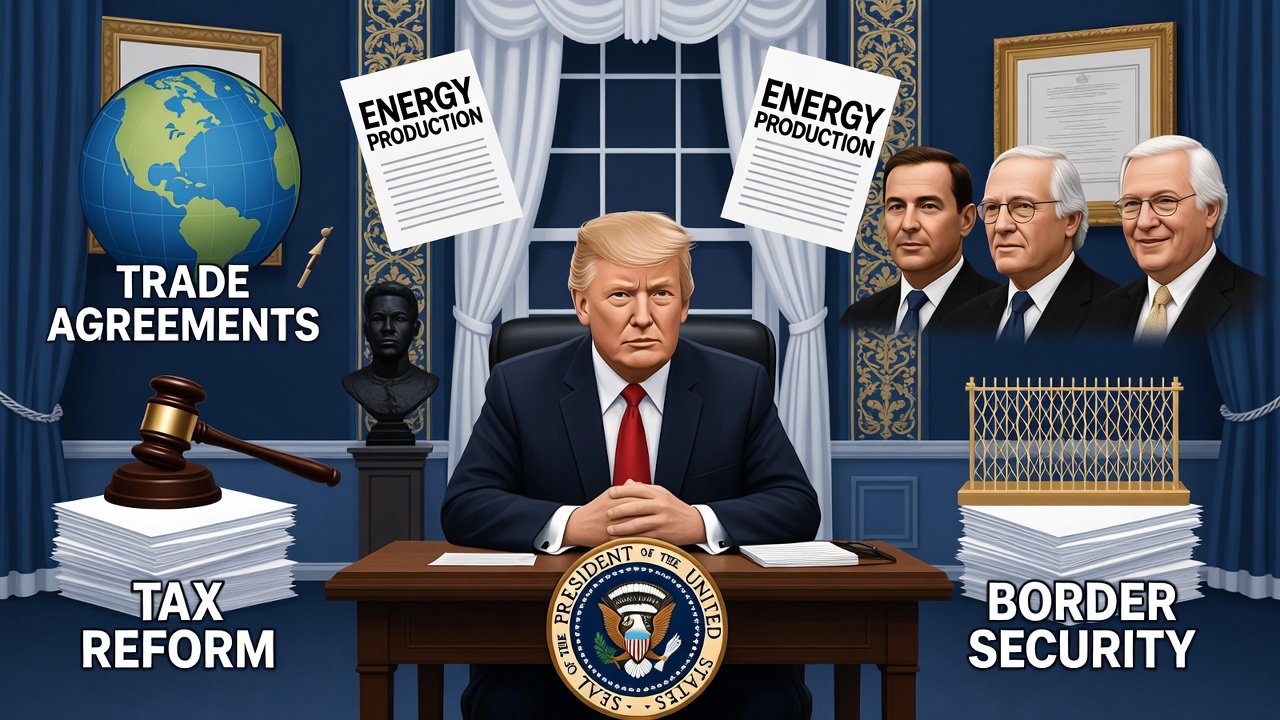
When Donald Trump took office in January 2017, he promised significant change across economic, immigration, trade, and national security policies. His administration pursued an agenda focused on tax reform, deregulation, border enforcement, trade renegotiation, and judicial appointments.
While reactions to these policies varied sharply across political lines, there is little dispute that they shaped the national conversation and left lasting effects on American governance.
This article examines five major policy areas that defined Trump’s first term (2017–2021) and analyzes their measurable impact on the United States.
1. The Tax Cuts and Jobs Act policies (2017)
One of the most significant legislative achievements of Trump’s presidency was the Tax Cuts and Jobs Act (TCJA), signed into law in December 2017.
Key Provisions:
- Reduced the corporate tax rate from 35% to 21%.
- Lowered individual income tax rates for many brackets.
- Doubled the standard deduction.
- Limited state and local tax (SALT) deductions.
- Changed the structure of international corporate taxation.
Intended Goals:
The administration argued that lowering corporate taxes would:
- Encourage domestic investment.
- Increase business expansion.
- Boost wages and job creation.
Impact:
In the short term:
- The U.S. economy experienced strong GDP growth in 2018.
- Unemployment reached historically low levels prior to the COVID-19 pandemic.
- Stock markets saw significant gains during early years of the term.
However, critics pointed out:
- The federal deficit increased following the tax cuts.
- Benefits disproportionately favored corporations and higher-income earners, according to various economic studies.
The TCJA remains one of the defining economic reforms of Trump’s first term and continues to influence fiscal policy debates today.
2. Immigration and Border Security Policies
Immigration enforcement was a central theme of Trump’s 2016 campaign and remained a priority throughout his presidency.
Key Actions:
- Increased border security funding.
- Attempted construction of a border wall along the U.S.-Mexico border.
- Implemented stricter asylum and refugee policies.
- Introduced travel restrictions affecting several predominantly Muslim-majority countries.
Border Wall Initiative:
The administration sought funding for expanded border barriers, framing it as essential for national security and immigration control. Portions of new and replacement fencing were constructed during the term.
Travel Restrictions:
The travel restrictions, often referred to as a “travel ban,” were challenged in court but ultimately upheld in revised form by the U.S. Supreme Court in 2018.
Impact:
Supporters argued these policies:
- Strengthened border enforcement.
- Reduced unauthorized border crossings during certain periods.
- Reinforced national security priorities.
Critics argued:
- Policies separated families at the border.
- Humanitarian concerns were not adequately addressed.
- Legal immigration pathways were narrowed.
Immigration policy became one of the most polarizing aspects of Trump’s presidency and significantly reshaped federal enforcement priorities.
3. Trade Policy and USMCA
Trump entered office with a strong critique of existing trade agreements, arguing they disadvantaged American workers.
Withdrawal and Renegotiation:
The administration:
- Withdrew from the Trans-Pacific Partnership (TPP).
- Renegotiated NAFTA, resulting in the United States-Mexico-Canada Agreement (USMCA).
- Imposed tariffs on steel and aluminum imports.
- Engaged in a trade dispute with China involving reciprocal tariffs.
USMCA:
The USMCA introduced:
- Updated digital trade provisions.
- Stricter labor standards.
- Revised automotive manufacturing rules.
- Greater market access for U.S. dairy products in Canada.
China Trade Conflict:
Tariffs were imposed on hundreds of billions of dollars in goods between the U.S. and China. The Phase One agreement in 2020 aimed to address intellectual property concerns and increase Chinese purchases of U.S. goods.
Impact:
Supporters claimed:
- The administration defended American manufacturing.
- The USMCA modernized outdated trade rules.
- Trade negotiations pressured China on intellectual property practices.
Critics noted:
- Tariffs increased costs for some U.S. businesses and consumers.
- Trade tensions created uncertainty in agricultural and manufacturing sectors.
Trade policy under Trump marked a departure from decades of bipartisan free trade consensus.
4. Deregulation and Energy Policy
Another hallmark of Trump’s first term was regulatory rollback, particularly in environmental and energy sectors.
Key Actions:
- Rolled back numerous federal regulations.
- Expanded oil and gas leasing on federal lands.
- Withdrew the U.S. from the Paris Climate Agreement.
- Approved pipeline projects such as Keystone XL (later halted under subsequent administration).
Energy Independence:
The administration emphasized domestic energy production. During parts of Trump’s term, the U.S. became a net exporter of energy products.
Impact:
Supporters argued:
- Deregulation reduced compliance costs for businesses.
- Energy production increased.
- Job growth expanded in certain energy sectors.
Critics raised concerns about:
- Environmental protection rollbacks.
- Long-term climate impacts.
- Increased greenhouse gas emissions.
Energy and regulatory policy shifts reflected a broader pro-business orientation of the administration.
5. Judicial Appointments and Supreme Court Nominations
Perhaps one of the most enduring aspects of Trump’s presidency was his influence on the federal judiciary.
Supreme Court Appointments:
Trump appointed three Supreme Court justices:
- Neil Gorsuch
- Brett Kavanaugh
- Amy Coney Barrett
These appointments shifted the ideological balance of the Court.
Federal Judges:
Over 200 federal judges were confirmed during his presidency.
Impact:
Supporters argued:
- The appointments strengthened constitutional originalism.
- The judiciary became more aligned with conservative legal philosophy.
Critics contended:
- The confirmations deepened partisan divisions.
- The ideological shift would influence major rulings for decades.
Judicial appointments are widely considered one of Trump’s most lasting policy legacies.
Broader Economic Context: COVID-19 Response
Though not a single policy area, the COVID-19 pandemic significantly shaped the final year of Trump’s presidency.
The administration:
- Signed major stimulus legislation.
- Expanded unemployment benefits.
- Supported business relief programs.
- Launched Operation Warp Speed to accelerate vaccine development.
The economic downturn in 2020 disrupted earlier growth trends. Recovery efforts became central to policy discussions during the transition to the next administration.
Long-Term Political and Policy Influence
Trump’s first term altered the trajectory of the Republican Party and national political discourse. Key themes that continue to shape policy debates include:
- Trade protectionism vs. free trade
- Immigration enforcement priorities
- Corporate tax structure
- Energy independence vs. environmental regulation
- Judicial philosophy
His policies sparked intense public debate, underscoring the deeply polarized nature of American politics during this period.
Conclusion
The first term of Donald Trump was defined by significant policy shifts across taxation, immigration, trade, deregulation, and the judiciary.
Supporters credit the administration with boosting economic growth, reshaping trade agreements, strengthening border enforcement, and appointing influential judges.
Critics point to rising deficits, environmental concerns, trade instability, and controversial immigration enforcement practices.
Regardless of political perspective, these five policy areas remain central to understanding the impact of Trump’s presidency on America’s economic and political landscape.

