

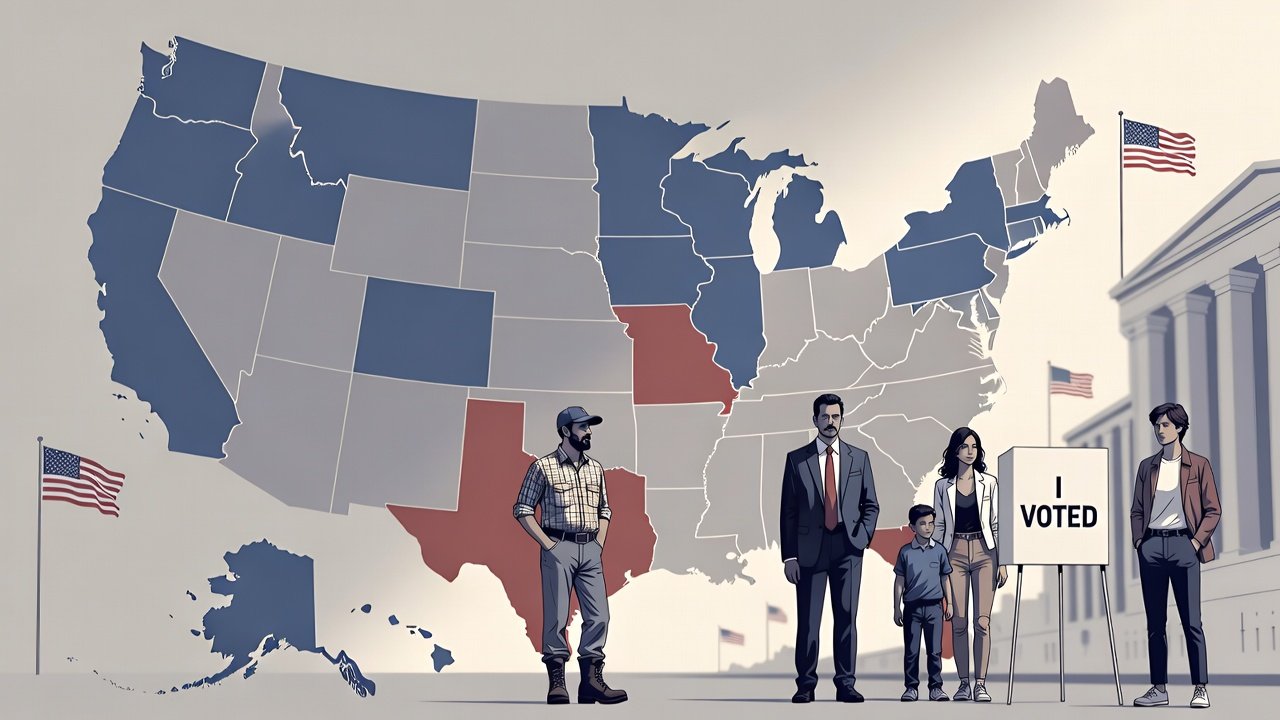
Political Republican coalitions in the United States evolve over time. Demographic shifts, economic trends, cultural changes, and candidate messaging all shape party alignment. During his rise and presidency, Donald Trump significantly influenced the composition of the Republican voter base. His campaigns in 2016 and 2020 reconfigured long-standing voting patterns, expanded support in certain communities, and reshaped the party’s strategic priorities.
- The Pre-2016 Republican Coalition
- Expansion Among White Working-Class Voters
- Regional Realignment in the Midwest
- Gains Among Hispanic Voters
- Black Voter Support Trends
- Education Divide: College vs. Non-College Voters
- Rural and Urban Polarization
- Evangelical and Religious Voters
- Youth Voters and Generational Dynamics
- Media Strategy and Demographic Outreach
- Economic Framing and Coalition Building
- Long-Term Impact on the Republican Party
- Electoral Implications Beyond 2020
- Broader Political Context
- Conclusion: A Reshaped Republican Coalition
This article examines how Trump influenced Republican voter demographics, focusing on working-class voters, regional realignments, minority support trends, education divides, and generational shifts. The goal is analytical clarity — presenting data-driven observations within a balanced, research-based framework.
The Pre-2016 Republican Coalition
Before Trump’s emergence, the modern Republican coalition typically emphasized:
- Suburban voters
- College-educated conservatives
- Evangelical Christians
- Business-oriented constituencies
While working-class voters were part of the coalition, the party often focused messaging on fiscal conservatism, limited government, and free-market economics.
Trump’s 2016 campaign altered that emphasis by foregrounding trade policy, border security, and cultural identity themes. These changes had measurable demographic effects.
Expansion Among White Working-Class Voters
One of the most widely discussed demographic shifts during Trump’s campaigns was his strong support among white voters without a college degree.
Factors Behind the Shift
Trump’s messaging resonated with voters concerned about:
- Manufacturing job losses
- Trade agreements
- Economic stagnation
- Cultural displacement
In several Midwestern states — including Michigan, Wisconsin, and Pennsylvania — working-class turnout and voting margins proved decisive in 2016.
Analysts note that Trump’s emphasis on economic nationalism distinguished him from prior Republican nominees who often prioritized free-trade orthodoxy.
Regional Realignment in the Midwest
The 2016 election revealed notable changes in regional voting patterns. States traditionally considered part of the Democratic “blue wall” shifted toward the Republican column.
These shifts reflected:
- Economic frustration in industrial regions
- Declining union density
- Rural-urban polarization
Trump’s campaign invested heavily in rally appearances and direct voter outreach in these states, reinforcing regional engagement.
The Midwest became a focal point of Republican electoral strategy moving forward.
Gains Among Hispanic Voters
While immigration policy debates generated controversy, Trump improved Republican performance among certain Hispanic communities between 2016 and 2020.
Data indicated notable gains in:
- South Florida
- South Texas border counties
Several explanations have been proposed:
- Economic opportunity messaging
- Religious values alignment
- Entrepreneurial emphasis
It is important to recognize that Hispanic voters are not a monolithic group. Voting patterns vary by region, national origin, and socioeconomic status.
Trump’s outreach strategies reflected increasing attention to demographic diversity within the Republican coalition.
Black Voter Support Trends
Republican candidates historically receive a smaller share of Black voters compared to Democratic candidates. Trump modestly increased Republican vote share among Black male voters in 2020 compared to 2016.
Factors contributing to this shift may include:
- Criminal justice reform legislation
- Economic messaging
- Outreach initiatives
While the overall percentage remained limited relative to other groups, the incremental gains attracted attention among political strategists analyzing coalition expansion opportunities.
Education Divide: College vs. Non-College Voters
Trump’s candidacies intensified the education divide in American politics. College-educated suburban voters shifted somewhat toward Democratic candidates during this period, while non-college voters became more strongly aligned with Republicans.
This education polarization reflects broader trends in cultural and political identity:
- College-educated voters increasingly cluster in metropolitan areas.
- Non-college voters are more concentrated in rural regions.
Trump’s messaging — emphasizing cultural and economic populism — resonated strongly among non-college constituencies.
The education divide has since become a defining feature of partisan alignment.
Rural and Urban Polarization
Trump strengthened Republican margins in rural America while Democratic candidates expanded support in urban centers.
Rural areas responded to:
- Economic revival themes
- Energy production advocacy
- Skepticism of federal regulation
Urban areas, meanwhile, reflected more diverse demographic compositions and policy priorities.
This geographic polarization contributes to intensified electoral competition in suburban swing districts.
Evangelical and Religious Voters
Evangelical Christian voters have long formed a core Republican constituency. Trump maintained high levels of support within this group, particularly after appointing conservative judges to the federal judiciary and the Supreme Court of the United States.
Judicial appointments reinforced alignment between religious voters and the Republican Party, solidifying turnout patterns.
Youth Voters and Generational Dynamics
Younger voters generally lean Democratic. However, Trump’s presence influenced generational engagement patterns in complex ways.
Among younger conservatives:
- Digital engagement increased
- Political identity intensified
- Social media mobilization expanded
Although younger voters overall favored Democratic candidates during Trump’s campaigns, his brand activated new levels of youth participation within conservative circles.
Media Strategy and Demographic Outreach
Trump’s use of platforms such as Twitter enabled direct communication across demographic lines. Digital microtargeting, email fundraising, and rally-based outreach contributed to turnout operations.
Campaign strategy increasingly relied on:
- Data analytics
- Behavioral targeting
- Direct voter messaging
These techniques enhanced the party’s ability to mobilize specific demographic groups.
Economic Framing and Coalition Building
Trump frequently framed electoral competition around economic revival, manufacturing investment, and domestic production.
Economic framing can cut across demographic categories. Messaging emphasizing job growth and wage gains appealed to:
- Industrial workers
- Small business owners
- Rural communities
Supporters viewed this approach as broadening the Republican coalition beyond traditional fiscal conservatives.
Critics argued that economic outcomes varied by region and sector.
Long-Term Impact on the Republican Party
Trump’s influence on voter demographics may have long-term implications for Republican strategy.
Key trends include:
- Stronger alignment with working-class voters
- Increased rural dominance
- Emerging minority outreach initiatives
- Heightened education-based polarization
Future Republican candidates must navigate this evolving coalition, balancing traditional conservative principles with populist energy.
Electoral Implications Beyond 2020
The demographic shifts observed during Trump’s campaigns continue to shape electoral calculations. Battleground states increasingly reflect:
- Narrow margins
- High turnout volatility
- Intensified demographic targeting
Strategists from both parties analyze these shifts to refine messaging and policy positioning.
Demographic realignment is rarely permanent; it evolves with social and economic conditions.
Broader Political Context
American party coalitions have realigned multiple times throughout history. The shifts observed during Trump’s candidacies fit within a broader pattern of political transformation.
Demographic influence intersects with:
- Economic cycles
- Media ecosystems
- Cultural trends
Trump’s campaigns accelerated some of these dynamics but did not operate in isolation.
Conclusion: A Reshaped Republican Coalition
Donald Trump’s influence on Republican voter demographics represents one of the most significant political realignments of the past decade. His campaigns strengthened support among white working-class voters, expanded outreach in select Hispanic communities, intensified the education divide, and reinforced rural dominance.
At the same time, suburban and college-educated voters exhibited shifting patterns that continue to shape electoral competition.
Understanding these demographic shifts requires careful analysis rather than oversimplification. Political coalitions are dynamic, and Trump’s impact illustrates how messaging, economic framing, and identity politics can reshape voter alignment in measurable ways.
As future elections unfold, the demographic evolution of the Republican Party will remain a central factor in American political strategy

