

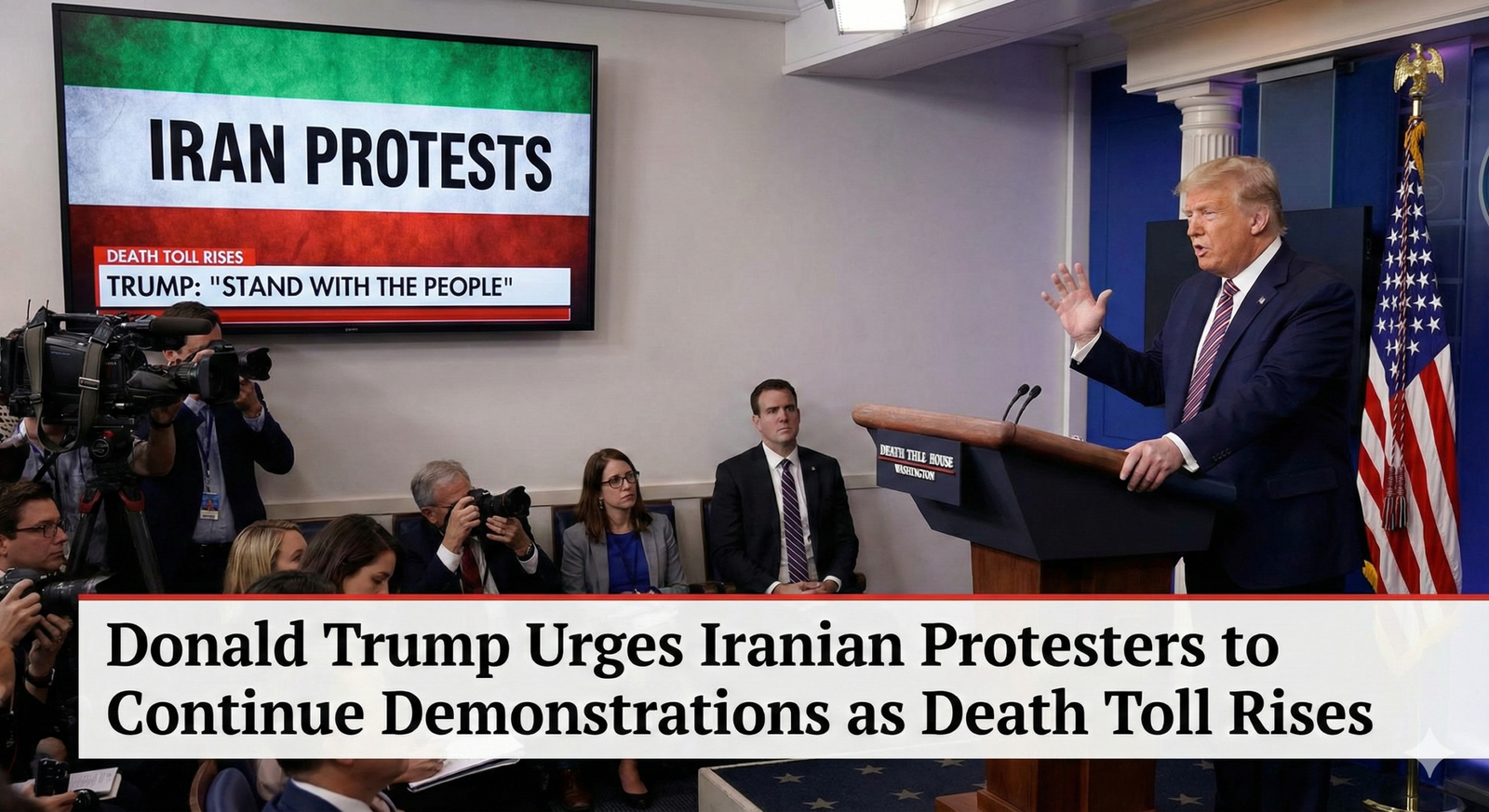
Trump Cancels Talks With Iran, Signals Possible Action Amid Nationwide Protests
Former US President Donald Trump has urged Iranian protesters to continue demonstrating against the Islamic Republic, declaring that “help is on its way” and announcing the cancellation of all planned meetings with Iranian officials. His remarks come amid escalating unrest across Iran, where human rights groups report hundreds of deaths following a violent government crackdown.
In a post shared on his Truth Social platform, Trump directly addressed protesters, calling them “Iranian patriots” and encouraging them to remain on the streets. He urged them to take control of institutions and document those responsible for violence, warning that “killers and abusers” would eventually “pay a big price.”
Trump said he had cancelled all diplomatic engagements with Iranian officials until what he described as the “senseless killing of protesters” comes to an end. While the precise nature of the cancelled meetings remains unclear, the statement marks a sharp escalation in rhetoric and raises questions about potential US action.
Strong Language Signals Shift in US Posture
Speaking briefly before boarding Air Force One, Trump declined to elaborate further, saying only that his Truth Social statement “speaks for itself.” However, analysts say the language used suggests a leader who believes the Iranian regime is under serious threat.
According to Washington-based observers, Trump’s call for protesters to “take over institutions” and preserve evidence against security forces implies he sees the current unrest as a historic turning point. Some believe he views the Iranian government as increasingly unstable and vulnerable to internal collapse.
Trump had previously indicated openness to diplomatic engagement with Iran, particularly on nuclear-related issues. Over the weekend, he acknowledged reports of Iranian outreach seeking dialogue. However, his latest comments suggest that diplomacy is no longer a priority and that decisive action could be imminent.
The phrase “help is on its way” has fueled speculation, though no concrete details have been provided. US officials have not confirmed any immediate plans, leaving observers uncertain about what form, if any, assistance might take.
Possible US Options and Risks
Any direct US involvement in Iran would carry significant risks. Military analysts note that Trump has a wide range of options short of deploying ground forces, which is considered highly unlikely.
Potential actions could include targeted airstrikes on strategic facilities, missile strikes from naval assets, cyber operations, or intelligence-based measures aimed at weakening the Iranian state’s ability to suppress protests.
Media reports have also discussed the possibility of information warfare or cyber campaigns designed to disrupt government communication and control.
What appears far less likely is a large-scale military operation or the deployment of US troops on Iranian soil. Historical precedents, particularly the failed 1979 hostage rescue mission under President Jimmy Carter, remain deeply ingrained in US political memory. Trump himself has recently referenced that episode as a warning against overly risky interventions.
While speculation continues, experts emphasize that even limited actions could provoke retaliation, destabilize the region, or escalate into broader conflict involving US allies and adversaries alike.
Scale of Protests and Human Rights Crisis
Inside Iran, the scale of protests continues to expand despite an intense crackdown by security forces. Human rights organizations report that at least 650 people have been killed, a figure based on verified cases prior to Iran’s near-total internet shutdown.
Since then, communication with the outside world has been severely restricted, making independent verification extremely difficult. Activists and journalists believe the true number of casualties may be far higher.
Despite the blackout, some Iranians have managed to transmit information using satellite internet, foreign SIM cards near border regions, or brief signal access from neighboring countries. Messages received by international media describe hospitals overwhelmed with injured protesters and morgues filled with the bodies of young men and women.
Images and testimonies indicate that families are lining up outside morgues and forensic centers to identify loved ones. In some cases, relatives have reportedly been forced to sign statements claiming the deceased were not protesters but innocent bystanders before authorities release the bodies.
Personal Accounts Reveal Brutal Reality
BBC Persian and other international outlets have spoken with Iranians living abroad who have family members trapped inside the country. One such journalist, Chamileia Antrabif, Editor-in-Chief of Independent Persian, described days of silence before finally hearing from her mother in Tehran.
According to her account, northern parts of the capital experienced sustained gunfire during what she described as the most violent night of the crackdown. Residents reported hearing automatic weapons fire into the early hours of the morning. Shops were forced to close early, and movement was heavily restricted.
Antrabif also said a close relative had been shot in the eye and remains hospitalized after losing his vision. Similar stories of severe injuries, including gunshot wounds and permanent disabilities, are emerging from cities across Iran. Such accounts paint a grim picture of widespread violence, fear, and trauma affecting families nationwide.
Internet Shutdown and Information Blackout
Iranian authorities have imposed one of the most extensive internet shutdowns in recent years, cutting off mobile data, social media platforms, and international communication channels. The blackout appears designed to prevent coordination among protesters and limit the flow of images and information to the outside world.
Despite these efforts, underground networks continue to operate. Protesters are reportedly coordinating through word of mouth, phone calls, university networks, and neighborhood communication chains. Some have also relied on satellite connections, though possession of such equipment carries significant personal risk.
Authorities have reportedly begun removing satellite dishes from rooftops in some areas, attempting to block access to foreign Persian-language television channels that continue to broadcast coverage of the protests.
Protests Continue Despite Crackdown
Despite the risks, demonstrations are ongoing in multiple cities, including Tehran and several northern regions. Reports indicate that new protests are forming nightly, even as security forces attempt to suppress them through arrests, gunfire, and intimidation.
What distinguishes this wave of unrest, according to observers, is its breadth. Protesters span all age groups, social classes, ethnic communities, and religious backgrounds. Unlike previous movements, this uprising appears to reflect a rare moment of national unity.
Many demonstrators are rallying under Iran’s historic lion-and-sun flag, a symbol used for centuries before being replaced following the 1979 Islamic Revolution. The flag has become a unifying emblem for those calling for systemic change.
Loss of Dignity and Demand for Change
Participants and observers alike describe the protests as driven by more than economic hardship. While inflation, unemployment, and sanctions have taken a heavy toll, many Iranians say the deeper issue is the loss of dignity, freedom, and international respect.
Before the revolution, Iran held a prominent position on the global stage. Many protesters believe decades of authoritarian rule have isolated the country and damaged its reputation. The current movement reflects a desire to reclaim both national pride and individual rights.
Young protesters, in particular, have drawn international attention for their courage. Footage and testimonies show unarmed demonstrators confronting heavily armed forces, often at great personal risk. Their actions have inspired both admiration and concern worldwide.
International Reaction and Uncertain Future
Trump’s statement has added a new layer of complexity to an already volatile situation. While some protesters may view his comments as encouraging, others fear that foreign involvement could provide the Iranian government with justification for further repression.
International leaders and human rights organizations continue to call for restraint, accountability, and the restoration of internet access. However, concrete action from the global community remains limited.
As protests continue and casualties mount, the future of Iran appears increasingly uncertain. Whether Trump’s words translate into tangible action—or remain rhetorical—remains to be seen.
For now, what is clear is that millions of Iranians are risking their lives to demand change, and the world is watching closely.

